The State of Pressure Washing in 2026: A Data-Driven Industry Report
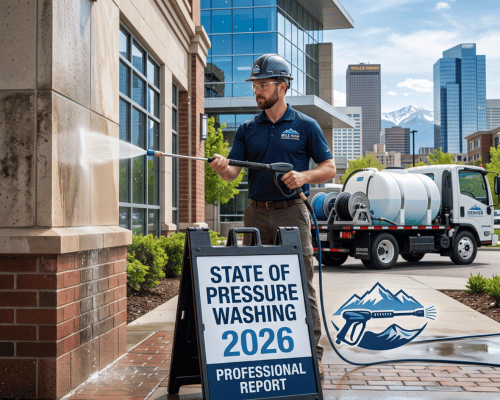
Published June 2026 · An independent industry analysis
Executive summary
The US pressure washing industry enters 2026 as a mature, fragmented market with consistent growth, intensifying competition, and meaningful regulatory complexity. Combined services and equipment revenue sits between $2.1 and $2.9 billion depending on methodology, with an estimated 32,000 to 75,000 active service businesses operating nationwide. The industry has compounded at roughly 5% annually over the past five years, with North America representing 35% of the global pressure washer equipment market.
For operators, 2026 represents both opportunity and pressure. Average residential job values have climbed to $275-$425, commercial contracts run $850 to $3,500, and operators successfully positioning into hybrid residential-commercial mixes report the strongest revenue stability. At the same time, customer acquisition costs have nearly doubled in competitive markets — Google Local Service Ads now run $18-$35 per lead, up 43% from 2024 levels — and time-to-first-job for new operators has stretched from 2-3 weeks in 2022 to 4-8 weeks in 2026.
Regulatory complexity continues to grow. EPA Clean Water Act enforcement, state-by-state contractor licensing variations, and municipal wastewater discharge permits create a compliance environment that surprises many new operators. Fines for improper wastewater disposal can reach $25,000 per day under federal regulations.
This report synthesizes data from IBISWorld, the US Census Bureau, the EPA, equipment market researchers, and trade publications to provide the most current picture of the US pressure washing industry available outside paywalled research databases.
Section 1: Market size and growth
Total industry revenue
Estimates of total US pressure washing industry revenue vary by methodology and what each researcher includes in the definition:
- Services-only estimate (IBISWorld, 2026): $1.2 billion, with 32,193 active businesses identified.[¹]
- Services-only estimate (Southeast Softwash analysis of IBISWorld data, 2025): $2.1-$2.3 billion in combined residential and commercial exterior cleaning services, including soft washing, roof cleaning, and related surface treatment.[²]
- Equipment market (Global Market Insights, 2026): $2.7 billion globally, projected to reach $4.2 billion by 2035 at 5.1% CAGR.[³]
- Equipment market (Mordor Intelligence, 2026): $5.74 billion globally, with North America at 35.5% revenue share.[⁴]
- Combined services + equipment estimate (6Wresearch, 2026): $2.9 billion, projected to reach $4.5 billion by 2032 at 6.5% CAGR.[⁵]
The variation reflects genuine methodology differences. IBISWorld's narrower services-only figure represents formal pressure washing service businesses tracked through US Census data. Broader estimates incorporate soft washing, roof cleaning, gutter cleaning, and related exterior cleaning services that operators often deliver alongside pressure washing. Equipment market figures include both consumer DIY purchases and commercial-grade equipment for service operators.
For operators benchmarking their business, the most relevant figure is likely the services-only estimate in the $1.2-$2.3 billion range, depending on how broadly "pressure washing services" is defined.
Number of active businesses
Counting active US pressure washing businesses requires triangulating multiple data sources because of the industry's fragmentation and low barriers to entry:
- IBISWorld (2026): 32,193 formal businesses.[¹]
- Industry estimates (Southeast Softwash analysis, 2025): 68,000-75,000 businesses identify as primarily providing pressure washing or related exterior cleaning services, drawing from US Census Nonemployer Statistics, Small Business Administration licensing data, and industry supplier estimates.[²]
The gap between these figures (roughly 35,000-43,000 businesses) reflects the substantial population of solo operators who may not appear in formal industry tracking. The US Census Nonemployer Statistics suggests the true number is closer to the upper estimate, with a large undercount of single-truck operations that file as sole proprietorships.
Growth rates
The pressure washing industry has shown consistent if unspectacular growth:
- Services revenue CAGR 2019-2024: 0.6% (IBISWorld)[¹]
- Active business count CAGR 2019-2024: 5.8% (IBISWorld)[¹]
- Employment growth 2019-2024: 5.7% (Housecall Pro industry analysis)[⁶]
- Equipment market projected CAGR 2026-2031: 5.12% globally, 5.65% in North America (Mordor Intelligence)[⁴]
The mismatch between low revenue growth (0.6%) and higher business count growth (5.8%) tells an important story: more operators are entering the market than total revenue growth supports. This dynamic — more competition chasing similar total revenue — directly drives the marketing cost increases discussed in Section 4.
Market fragmentation
The US pressure washing services industry is highly fragmented, with no single company holding greater than 5% market share according to IBISWorld.[¹] This contrasts with adjacent industries (lawn care, where TruGreen alone holds ~6%, or HVAC, where Service Experts and ARS commercial residential combined approach double-digit share). For independent pressure washing operators, this fragmentation is both opportunity (no dominant national brand to displace) and challenge (no economies of scale via consolidation).
Franchise pressure washing brands report 15% higher average revenues than independent operators, according to industry data, though franchise penetration remains modest.[⁷]
Section 2: Business model and operator economics
Operator profiles
The US pressure washing industry breaks into roughly three operator categories:
Solo operators — Single owner-operator, typically one truck, mix of residential and small commercial work. Net profit after taxes averages approximately $65,000 in recent industry data.[⁷] Gross annual revenue typically ranges $50,000-$200,000.[⁸]
Small crews (2-5 employees) — One to two trucks, expanded residential capacity, beginning commercial contracts. Revenue typically $150,000-$500,000 annually.
Multi-truck operations (6+ employees) — Significant commercial contract base, dedicated commercial sales, fleet of 3+ trucks. Multi-truck operations achieve approximately 25% cost economies of scale compared to solo operators.[⁷] Revenue typically $500,000-$2 million+ annually.
Service mix economics
Operator service mix varies significantly by business size:
- Solo and small operators derive 75-85% of revenue from residential clients.[²]
- Multi-truck operations with dedicated commercial divisions often generate 50-65% of revenue from commercial contracts.[²]
This pattern reflects natural business evolution. Residential work provides consistent cash flow, immediate payment, and easier customer acquisition. Commercial contracts provide larger revenue events, longer customer lifetime value, and more stable income but require professional bidding capabilities, longer sales cycles, higher insurance requirements, and longer payment cycles (30-60 days versus immediate residential payment).[²]
Average pricing in 2026
Residential pricing has trended upward consistent with broader home services inflation:
- Residential job average (2026): $275-$425 per appointment[²]
- Standard house wash: $250-$500[²]
- Average residential time per job: 2-4 hours including travel
- Experienced operator hourly target: $100-$150 per hour gross revenue[²]
- Industry hourly equivalent: $0.25 per square foot[⁷]
Commercial pricing operates on different economics:
- Average commercial job value: $850-$3,500[²]
- Larger commercial contracts (retail centers, multifamily properties, industrial facilities): $5,000-$25,000+[²]
The commercial market has proven more resistant to commoditization and price competition. Property managers and facility directors prioritize reliability, insurance coverage, and professional operations over lowest-bid pricing, creating opportunities for established operators to command premium rates.[²]
Cost structure
Average expense breakdown for mid-sized pressure washing firms (2023-2024 data, the most recent available):[⁷]
- Labor costs: 35% of total expenses
- Vehicle maintenance: ~$4,200 per truck per year
- Chemical supplies: ~$1,200 per month per average operator
- Equipment depreciation: ~10% of financials annually
- Bad debt write-offs: ~1.2% of revenue
- Average accounts receivable collection period: 25 days
Software adoption among operators reduces administrative costs by an estimated 18% on average for those who systematically adopt scheduling, invoicing, and customer management tools.[⁷]
Equipment investment
Starting equipment investment varies significantly by operational ambition:
- Entry-level mobile setup: $3,000-$8,000 (pressure washer, hoses, basic chemicals, mobile water tank)
- Professional mobile setup: $15,000-$35,000 (commercial-grade hot water unit, water reclamation system, mounted trailer setup, chemical storage)
- Multi-truck commercial setup: $50,000+ per truck for fully-equipped commercial operations
Hot water units carry a substantial premium over cold water systems but unlock higher-value commercial work. Cold water systems remain dominant at approximately 85-90% of the equipment market.[³]
Seasonality
Pressure washing revenue is meaningfully seasonal in most US markets:
- Peak revenue: Q2 (spring), with seasonal revenue +35% above baseline[⁷]
- Secondary peak: Early fall (September-October)
- Lowest revenue: Q4 in northern markets (December-February), particularly in regions with freezing temperatures
Geographic markets without winter freezing (Florida, Texas, Arizona, southern California) experience flatter seasonality and allow year-round operation.
Section 3: Customer behavior and demand
Demand drivers
Pressure washing demand has been driven by several converging factors:
- Inflation settling at ~3% entering 2026, combined with disposable personal income up 5.2% year over year, has given homeowners more flexibility for discretionary home services.[⁸]
- Annual spending on home improvements and maintenance is expected to reach $466 billion through mid-2025, providing macro tailwind for exterior cleaning services.[⁸]
- Post-pandemic hygiene awareness drove a 4.1% year-over-year growth in commercial pressure washing services in 2023, with elevated demand persisting through 2026.[⁷]
Geographic concentration
The US pressure washing industry concentrates in specific geographic patterns:
- Highest density in southern and southwestern states (Florida, Texas, Georgia, Arizona, California) where year-round operation is possible
- Strongest seasonal markets in the Mid-Atlantic and Midwest where spring/summer demand spikes drive most annual revenue
- Highest job pricing in major metro markets (Los Angeles, New York, San Francisco, Boston, DC) where labor costs and home values support premium pricing
Customer acquisition channels
Successful pressure washing operators typically combine multiple acquisition channels:
- Google Business Profile and local pack rankings: ~60% of "pressure washing near me" search clicks go to the three businesses appearing in the local pack[⁹]
- Referrals: Highest-converting channel with close rates of 60-80% (versus 20-35% for paid search)[⁹]
- Paid search (Google Ads, Local Service Ads): Fastest-acting channel but increasingly expensive
- Social media (Facebook, Instagram): Effective for visual before/after content
- Door hangers and direct mail: Still effective for neighborhood-specific targeting after a visible job
The trend in 2026: operators who succeed treat customer acquisition as a multi-channel system rather than relying on any single source. Single-channel operators (typically Google Ads only) struggle when ad costs increase.
Customer behavior trends
Approximately 70%+ of pressure washing searches occur on mobile devices, making mobile-optimized customer experience non-negotiable.[⁹]
About 90%+ of consumers read online reviews before hiring a home services business. Businesses with 50+ reviews and 4.7+ average ratings capture disproportionate share of Local Pack clicks.[⁹]
Section 4: Marketing and customer acquisition economics
The rising cost of customer acquisition
Customer acquisition costs in pressure washing have increased substantially since 2023:
- Google Local Service Ads cost per lead: $18-$35 in competitive markets in 2026, up 43% from $12-$24 in early 2024[²]
- Google Ads cost per click for pressure washing terms: $2-$25 depending on market competition, with $8-$25 typical for "pressure washing near me" in mid-size to major metros[¹⁰]
- Typical monthly Google Ads budget for a solo operator: $500-$1,500[¹⁰]
- Major metro markets: $2,000+ per month often required for adequate visibility[¹⁰]
These cost increases reflect two converging factors: more operators entering the market and competing for the same keywords, and Google's algorithmic adjustments that have generally increased platform revenue per query.[²]
Customer acquisition timelines
The time-to-first-job for new operators has lengthened significantly:
- 2022-2023: 2-3 weeks from launch to first paying customer (typical)
- 2026: 4-8 weeks from launch to first paying customer (typical)[²]
The cause: market saturation in popular metros plus increased SEO difficulty. Markets that previously allowed new businesses to achieve first-page rankings within 60-90 days now frequently require 6-12 months of consistent optimization, content creation, and review generation.[²]
Cost per booked job
Reported customer acquisition costs vary by channel:
- Referrals: Effectively $0-$10 per booked job (excluding any referral incentives)
- Google Local Service Ads: $25-$60 per booked job in most markets (accounting for typical close rates)
- Google Ads (paid search): $40-$120 per booked job
- Facebook/Meta ads: $30-$80 per booked job (highly dependent on creative quality)
- Lead generation platforms (Angi, Thumbtack, HomeAdvisor): $20-$80 per lead (not per booked job)
Website and digital presence
Three core trends in pressure washing digital marketing in 2026:
-
Mobile-first experience is essential. 70%+ of pressure washing searches occur on mobile devices.[⁹]
-
Before/after photo content drives conversion. Pressure washing has a structural visual advantage — dramatic transformations that other trades cannot match. Operators who invest in consistent before/after photography see meaningfully higher conversion rates across paid and organic channels.
-
Review velocity matters more than total review count. Recent reviews (within 30 days) influence Local Pack rankings disproportionately compared to old reviews. Operators who systematically request reviews after every job outperform those with older review bases.
Section 5: Regulatory and compliance environment
Federal environmental regulation
Pressure washing operations are subject to federal regulation under the Clean Water Act and EPA enforcement. The most relevant rules:
National Pollutant Discharge Elimination System (NPDES): The EPA prohibits point source discharge of pollutants into US waters without an NPDES permit. Pressure washing wastewater — which typically contains detergents, oils, grease, debris, and dissolved contaminants from the cleaned surfaces — is classified as pollutant discharge.[¹¹] For mobile operators, obtaining NPDES permits for each discharge location is generally impractical, making capture and proper disposal the standard compliance path.[¹²]
Federal Clean Water Act penalties: Improper wastewater discharge can result in fines up to $25,000 per day under federal regulations.[¹³]
Lead Renovation, Repair, and Painting (RRP) Rule: Pressure washing on pre-1978 housing must comply with EPA RRP containment requirements when disturbing lead-based paint.[¹⁴]
State-level licensing requirements
Licensing requirements vary dramatically by state:
- California: Pressure washing license required through the Contractors State License Board. Requires age 18+, four years of journeyman experience, $300 application fee, $180 license fee.[¹⁵]
- Arizona: Contractor's license required for commercial pressure washing.
- Oregon: Contractor's license required.
- Michigan: No specific pressure washing license required, but wastewater discharge permit from EGLE typically required, especially when working near waterways.[¹⁵]
- Washington: Strict stormwater regulations. Many municipalities require stormwater discharge permits. Department of Ecology oversees compliance.[¹⁵]
- Colorado: Environmental permits required for commercial pressure washing in many counties.[¹⁵]
- Most other states: General business license at minimum ($25-$100 typical cost), with municipal-level requirements layered on top.[¹⁵]
Insurance requirements
General liability insurance is essentially required for any commercial pressure washing work. Most commercial clients and property managers require proof of insurance before hiring an operator. Budget guidance: $500-$2,000 per year for general liability coverage typical for solo operators, with higher coverage requirements for larger operations.[¹⁵]
Penalty exposure
The penalty environment is meaningful:
- Operating without required licenses: $500-$10,000 fines depending on jurisdiction[¹⁵]
- Repeat licensing violations: Can lead to business closure orders[¹⁵]
- Environmental violations (improper wastewater disposal): Up to $25,000 per day under federal Clean Water Act[¹⁵]
- EPA Clean Water Act violations: Can include criminal penalties for willful violations
For operators, the regulatory environment makes proper compliance both a cost center and a competitive advantage. Operators investing in wastewater reclamation systems, biodegradable chemicals, and proper licensing can credibly differentiate themselves to commercial property managers and government contracts that increasingly require documented compliance.
Section 6: Equipment and technology trends
Power source shifts
The pressure washing equipment market is shifting in three notable directions:
Electric and battery-powered growth: Battery-powered pressure washers held 13.2% of global 2025 equipment demand and are projected to expand at 12.85% CAGR through 2031 — the fastest among all power sources.[⁴] Electric (corded) pressure washers generated $1.1 billion in 2025 revenue, growing at 5.4% CAGR.[³] Battery and electric units appeal to environmentally-conscious consumers and operators working in noise-restricted zones (residential developments, hospitals, schools).
Gas-powered remains dominant for commercial work: Gas-based units retain the majority of commercial and industrial market share due to higher pressure capabilities (typically 3,000+ PSI) and unrestricted mobility. Higher pressure units (above 4,000 PSI) are projected to grow at 11.65% CAGR.[⁴]
Hot water systems for commercial: Cold water systems dominate at 85-89% of total market.[³][⁴] Hot water units are projected to grow at 9.45% CAGR, faster than cold water, driven by commercial cleaning demand where hot water dramatically improves grease and oil removal.[⁴]
Water reclamation systems
Water reclamation and reuse systems have become increasingly relevant given regulatory pressure:
- California drought regulations have driven adoption of 80% water reclamation loops among operators serving commercial accounts.[⁴]
- Municipal wastewater requirements in environmentally sensitive watersheds (notably WSSC Water service area in Maryland) mandate on-site wastewater reclamation.[¹²]
- Vacuum recovery units that capture pressure washing wastewater have become standard equipment for operators serving commercial accounts.
The financial logic: reclamation systems cost $2,000-$15,000 in additional equipment investment but unlock commercial contracts that require documented water management practices, plus reduce risk of environmental violations.
Smart features and IoT
Pressure washing equipment is gradually incorporating smart features:
- Bluetooth diagnostics: Smart sensors that alert operators to low oil, pump issues, or maintenance needs
- IoT and remote control for industrial-grade washers
- Smart unloader valves that protect pumps in bypass scenarios
- App-based scheduling and CRM integration within the broader operator software stack[¹⁶]
Sustainability-driven product development
Equipment manufacturers are responding to operator and customer pressure for sustainability:
- Eco-surfactants that reduce water use by approximately 50%[⁵]
- Low-flow nozzles that conserve 30% water in drought-affected areas[⁵]
- Biodegradable cleaning agents increasingly required for commercial accounts and environmentally sensitive areas
- UV-resistant hoses rated to 10,000 PSI burst pressure for longer service life
Equipment market leaders
Major equipment brands serving the US pressure washing market include Kärcher, Nilfisk, Briggs & Stratton, Generac, Simpson, Hotsy, Mi-T-M, DEWALT, Stanley Black & Decker, Ryobi, and Craftsman. Kärcher, Nilfisk, Briggs and Stratton, DiBO, and Gates collectively account for approximately 48% of global equipment revenue.[⁴]
Section 7: Labor market
Total employment
The US pressure washing industry employs approximately 41,799 technicians as of 2024 data.[⁸] Employment grew at approximately 5.7% annually from 2018-2024, outpacing services revenue growth of 0.6%, suggesting either declining productivity per technician or shifting compensation toward lower-paid roles as operations scale.[⁶]
Compensation
Pressure washing technician compensation varies significantly:
- Entry-level technician (no experience): $14-$18 per hour typical
- Experienced technician: $18-$28 per hour typical
- Crew leader / supervisor: $24-$35 per hour typical
- Owner-operator effective hourly rate: $40-$80 per hour after expenses for established solo operators
Compensation typically includes performance bonuses tied to job completion or upsell, particularly in commercial-focused operations.
Labor challenges
The pressure washing industry faces labor challenges common to outdoor service trades:
- Seasonal hiring difficulty: Spring hiring needs spike just as broader landscaping, construction, and agriculture sectors also ramp up hiring
- High turnover: Industry estimates suggest 40-60% annual turnover for entry-level technicians
- Physical demands: Heat exposure, equipment weight, repetitive motion, and outdoor weather make pressure washing physically demanding
- Training time: New technicians typically require 4-8 weeks before being productive at full speed
Larger operations increasingly invest in safety training, retention bonuses, and career progression frameworks to reduce turnover impact on revenue.
Section 8: 2026 outlook
Trends to watch
Several trends are reshaping the US pressure washing industry in 2026 and into 2027:
1. Commercial market expansion. Commercial contracts continue to outpace residential in growth rate and have proven more resistant to price competition. Operators successfully positioning into commercial work (property managers, retail centers, multifamily, fleet washing, industrial) capture larger revenue events and more stable income. Expect continued operator migration from pure residential to hybrid residential-commercial models.
2. Continued marketing cost inflation. Customer acquisition costs through Google Ads and Local Service Ads have risen 40%+ since 2024 with no clear ceiling in sight. Operators relying solely on paid acquisition will face margin compression. Expect more emphasis on referral systems, content marketing, and Google Business Profile optimization as cost-effective alternatives.
3. Battery and electric equipment adoption. Battery-powered pressure washers are growing 12.85% annually — the fastest of any equipment segment. While gas remains dominant for commercial work, residential operators increasingly find electric and battery options viable, particularly for noise-sensitive contexts.
4. Regulatory tightening. Federal and state environmental regulations governing wastewater discharge continue to tighten. The proposed 2026 Multi-Sector General Permit (MSGP) from the EPA increases stormwater compliance requirements.[¹⁷] Operators investing in proper compliance can credibly differentiate from competitors who treat regulations as optional.
5. AI-driven operations. Pressure washing operators are gradually adopting AI tools for customer service (automated booking and quote generation), route optimization, and dynamic pricing. The technology is early-stage but moving quickly. Expect AI-enabled operations to provide measurable cost advantages for early adopters by 2027.
Threats
1. Continued market saturation. Active business count is growing at ~5.8% annually while industry revenue grows at ~0.6%. More operators are chasing similar total revenue, which compresses per-operator economics over time. Markets without active operator attrition will face increasing competitive pressure.
2. Economic sensitivity. Pressure washing is discretionary residential spending. Economic downturns historically reduce residential demand 15-25%. The 2026 economic environment includes meaningful recession risk for portions of the year.
3. Climate-driven water restrictions. Drought conditions in California, Texas, Arizona, and other western states are driving water use restrictions that affect both pressure washing operations and customer willingness to pay for exterior cleaning. Expect this pressure to intensify through 2030.
4. Lead-generation platform disintermediation. Platforms like Angi, Thumbtack, and HomeAdvisor capture lead value from operators while extracting fees. As these platforms become more dominant in customer search, operator margins compress further. Operators able to build direct customer relationships (review systems, referrals, direct booking) are better positioned long-term.
Opportunities
1. Commercial recurring contracts. Property managers, retail center owners, multifamily property operators, and industrial facility managers increasingly value reliable, insured, compliance-documented pressure washing partners. The shift from one-off bidding to multi-year service agreements favors operators who invest in professional operations.
2. Specialty services with higher margins. Roof cleaning (soft washing), gutter cleaning, fleet washing, and specialty exterior treatments command higher margins than basic driveway and house washing. Specialization can offset competitive pressure on commodity services.
3. Franchise consolidation. Franchise pressure washing reports 15% higher average revenues than independent operations.[⁷] Franchise systems are growing, with several emerging franchise brands targeting the $200K-$1M operator segment for acquisition or franchise conversion.
4. Eco-positioning for premium markets. Operators credibly positioning around sustainability (water reclamation, biodegradable chemicals, proper compliance) can command premium pricing in environmentally-conscious markets, particularly California, Pacific Northwest, and major metro coastal markets.
Methodology and sources
This report synthesizes data from multiple sources to provide the most current available picture of the US pressure washing industry. Where sources disagree, both figures are presented with attribution to allow readers to evaluate the variation.
Primary data sources:
[1] IBISWorld. "Pressure Washing Services in the US — Industry Analysis." Updated 2026. https://www.ibisworld.com/united-states/industry/pressure-washing-services/6538/
[2] Southeast Softwash. "The State of the Pressure Washing Industry in 2026: Market Analysis, Growth Trends, and What's Ahead." Published 2025. https://southeastsoftwash.com/blogs/blog/the-state-of-the-pressure-washing-industry-in-2026
[3] Global Market Insights. "Pressure Washer Market Size, 2026-2035 Trends Report." December 2025. https://www.gminsights.com/industry-analysis/pressure-washer-market
[4] Mordor Intelligence. "Pressure Washer Market Size, Trends, Share & Global Report 2026-2031." January 2026. https://www.mordorintelligence.com/industry-reports/pressure-washer-market
[5] 6Wresearch. "Pressure Washing Market — Size & Trends." 2026. https://www.6wresearch.com/market-takeaways-view/how-big-is-the-market-for-pressure-washing
[6] Pressure Washing Industry Statistics (Housecall Pro analysis). 2026. https://www.housecallpro.com/resources/pressure-washing-industry-statistics/
[7] Pressure Washing Industry Statistics Market Data Report (Gitnux). February 2026. https://gitnux.org/pressure-washing-industry-statistics/
[8] Jobber Academy. "Pressure Washing Industry Statistics and Trends." 2025. https://www.getjobber.com/academy/pressure-washing/pressure-washing-industry-statistics/
[9] BSPKN. "Pressure Washing Marketing: How to Get More Customers and Build a Scalable Business in 2026." 2026. https://www.bspkn.co/insights/pressure-washing-marketing-get-more-customers-2026/
[10] Clean Marketing. "Google Ads for Pressure Washing: Full Guide." May 2026. https://cleanmarketing.net/google-ads-for-pressure-washing-how-to-get-leads-as-fast-as-tomorrow/
[11] US EPA. National Pollutant Discharge Elimination System (NPDES) Regulations. https://www.epa.gov/npdes
[12] WSSC Water. "Mobile Cleaner and Power Washing Best Management Practices." https://www.wsscwater.com/sites/default/files/sites/wssc/files/pollution%20prevention/Mobile%20Power%20Washing%20Best%20Management%20Practices-Draft.pdf
[13] Cleaner Times. "Power Washers' Guidebook: Environmental Concerns." 2022. https://www.cleanertimes.com/magazine/cleaner-times-articles-2/power-washers-guidebook-environmental-concerns-part-i/
[14] US EPA. "Lead Renovation, Repair, and Painting (RRP) Rule — Pressure Washing Application." March 2026. https://www.epa.gov/lead/how-do-rrp-requirements-apply-pressure-washing-what-containment-and-other-preparation-are
[15] Bella FSM. "Do You Need a License to Start a Pressure Washing Business?" 2026. https://www.bellafsm.com/need-license-to-start-pressure-washing-business/
[16] Mordor Intelligence Pressure Washer Market Report sustainability segment analysis. January 2026.
[17] US EPA. "Proposed 2026 Multi-Sector General Permit (MSGP) Fact Sheet." December 2024. https://www.epa.gov/system/files/documents/2024-12/proposed-2026-msgp-fact-sheet.pdf
Methodology notes:
This report does not include proprietary data from any single source. All statistics are drawn from publicly available industry research, government data sources, and industry trade publications. Where multiple sources provide different figures for the same metric, this report presents the range with attribution rather than selecting a single number.
Industry research firms (IBISWorld, Mordor Intelligence, Grand View Research, Global Market Insights, 6Wresearch, Coherent Market Insights) use different methodologies and definitions of "pressure washing market," which is the primary source of variation in headline figures.
For operators using this report for business planning, the most defensible figures are those that appear consistently across multiple sources: ~5% annual growth in equipment market, ~$1.2-$2.3 billion in services revenue, ~32,000-75,000 active service businesses, residential job average $275-$425, and customer acquisition costs of $25-$60 per booked job through major paid channels.
This report was researched and compiled in June 2026. Industry data evolves continuously — operators are encouraged to verify current statistics from cited primary sources for time-sensitive decisions.
Published by Mighty Sites — a platform helping local service businesses establish their online presence.